News
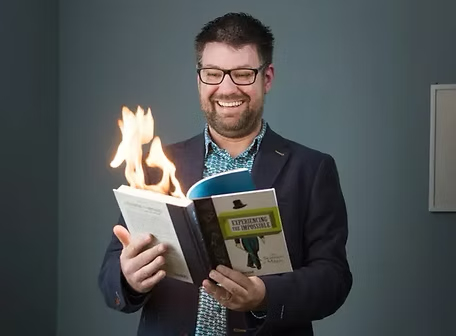
Gustav Kuhn, Professor of the Science of Magic and Director of the MAGIC Lab at the University of Plymouth. He uses magic to study the human mind and applies psychological research to help magicians understand and improve their art.
When magicians meet for the first time, one question is almost inevitable: “What kind of magic do you do?” Card magic? Coins? Mentalism? Close up? Stage? Without thinking about it, we organise magic into categories. Psychologists call these systems of categories taxonomies, but magicians have been creating them for generations.
Some classifications focus on props, such as cards or coins. Others describe the performance setting: close up, parlour, or stage. More conceptual systems classify the effect itself: productions, vanishes, transformations, restorations, penetrations, predictions, and so on. Each system has its uses. However, there is no universally accepted taxonomy of magic. Even familiar categories can overlap. Where, for example, does card magic end and micro magic begin? At what point does an amusing parlour act become comedy magic? A useful taxonomy should have categories that are clear and reasonably distinct. Achieving that is harder than it sounds.
Letting audiences organise magic
I am Professor of the Science of Magic and Director of the MAGIC Lab at the University of Plymouth. We use magic to study the human mind, but we also use psychological research to help magicians understand and improve their art.
Magicians have accumulated a vast amount of practical knowledge by observing their audiences. Science builds on that knowledge by testing whether our intuitions are correct. This matters because sometimes they are not. For example, our research suggests that the cross cut force can work just as well without time misdirection, while simply asking someone to name a card may not feel as free as many magicians assume. The aim is not to replace artistic creativity. It is to give magicians another set of tools.
This brings me to our new taxonomy of magic effects. Rather than asking magicians to decide which tricks belong together, we asked potential audience members how similar different effects felt. We then used their responses to identify natural groupings. In other words, we allowed audiences to organise the magic. Our taxonomy differs from earlier systems in two important respects: it is based on audience judgements, and it distinguishes the effect from its apparent cause.
The effect is not the cause
Our taxonomy focuses on what the audience experiences, rather than on the secret method or the object being used. If a card disappears and a coin disappears, both are vanishes. The prop changes, but the basic effect does not.
The most important feature of our system is that it separates two questions:
- What happened?
- What apparently caused it?
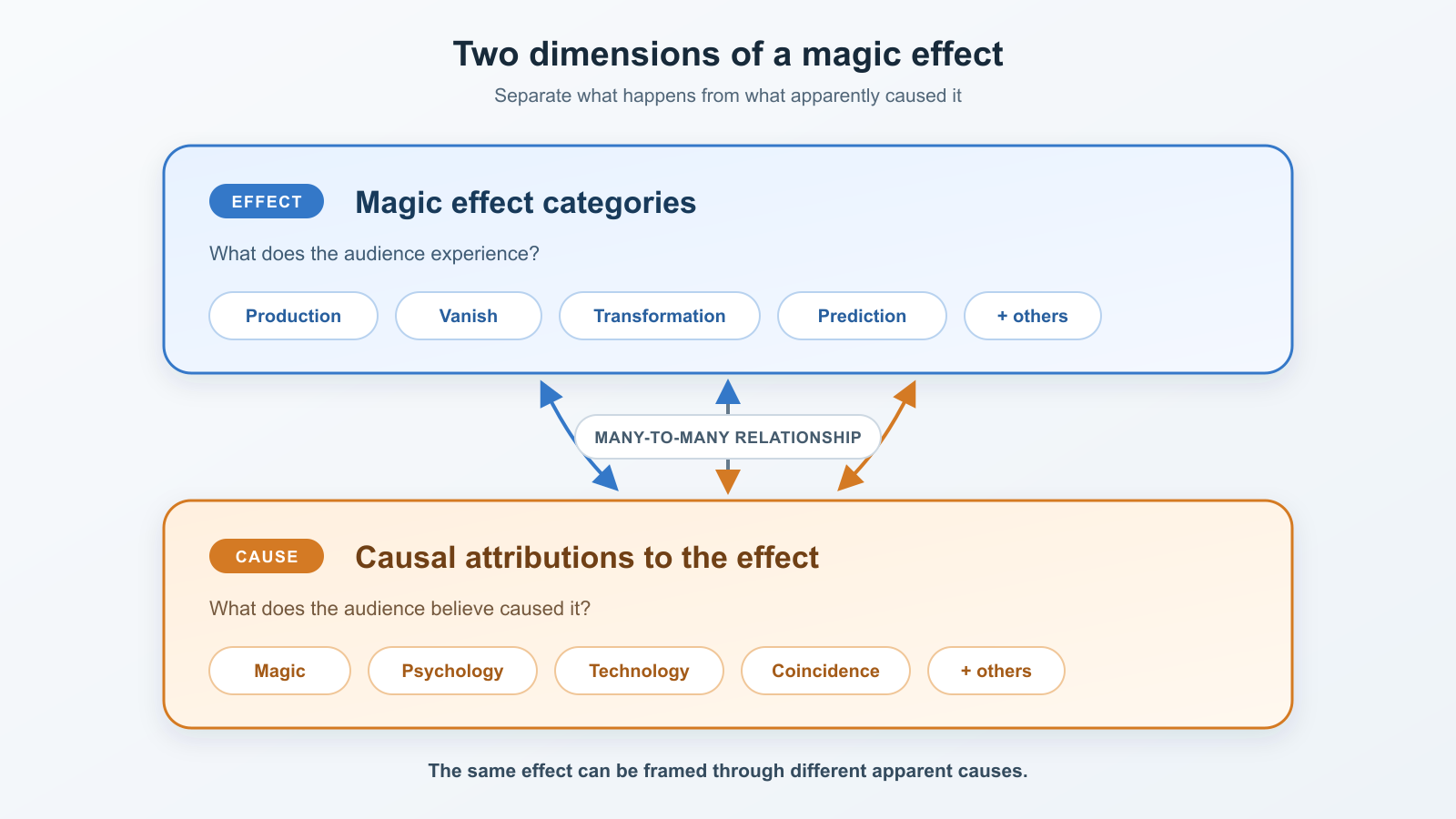
Magicians spend a great deal of time thinking about the first question. We devote less attention to the second. Suppose an object vanishes. What are you asking the audience to believe caused the disappearance? Was it a magical gesture, a spoken spell, or futuristic technology? I am not talking about the real method. I mean the apparent cause suggested by your presentation. In some instances, this causal attribution makes very little difference. In others, it can fundamentally change the way your audience perceives the trick.
Consider a spectator who thinks of a playing card and a performer reveals its identity. The performer could present this as mind reading or as an expert interpretation of body language. The basic effect is the same: hidden information has been discovered. But the implied cause, and therefore the audience’s experience of the trick, is very different.
Incorporating this distinction between an effect and its causal attribution allows us to classify effects more systematically, which is important for those of us who study magic scientifically. More importantly, it offers a practical tool for performance. I have watched many tricks in which objects vanish, transform, or appear in unexpected places, yet the presentation gives no indication of why anything is happening. The method may be excellent, but the effect can feel like a sequence of unexplained events. Clear causation can turn a puzzle into a story.
A map of magical experience
Another distinctive feature of our taxonomy is that it is based on audience data. Our participants judged the similarity of 47 different effects, including effects involving vanishing, appearing, transforming, moving, and extracting information. Their responses produced a map showing which effects audiences experience as closely related.
Some reassuring patterns emerged. For example, participants clearly distinguished object based effects from those involving thoughts and information, the territory magicians commonly associate with mentalism. The figure below shows the relationships among the different effects. Effects within the same group were judged to be more similar; the farther apart two effects are on the map, the more different participants considered them.
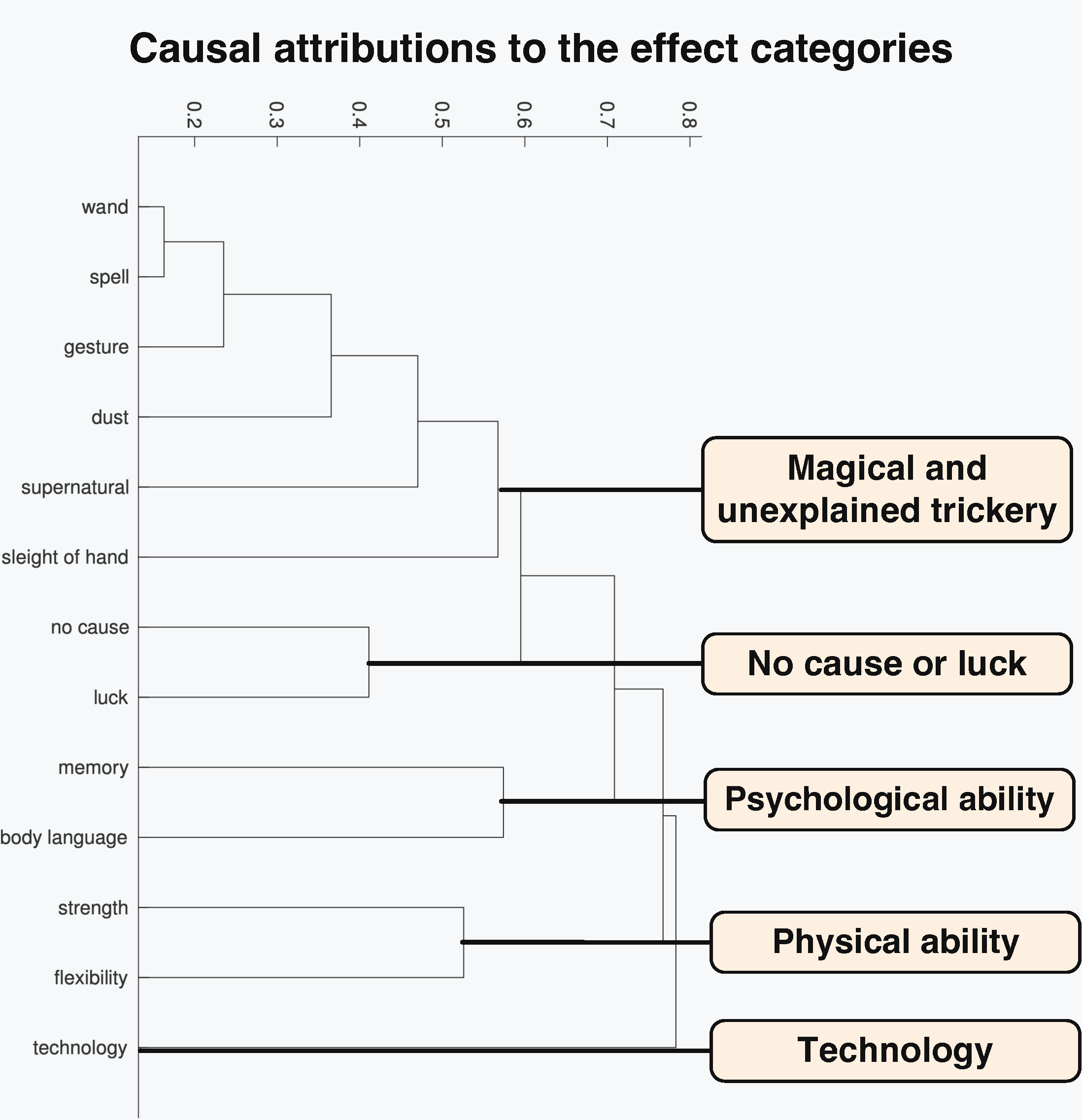
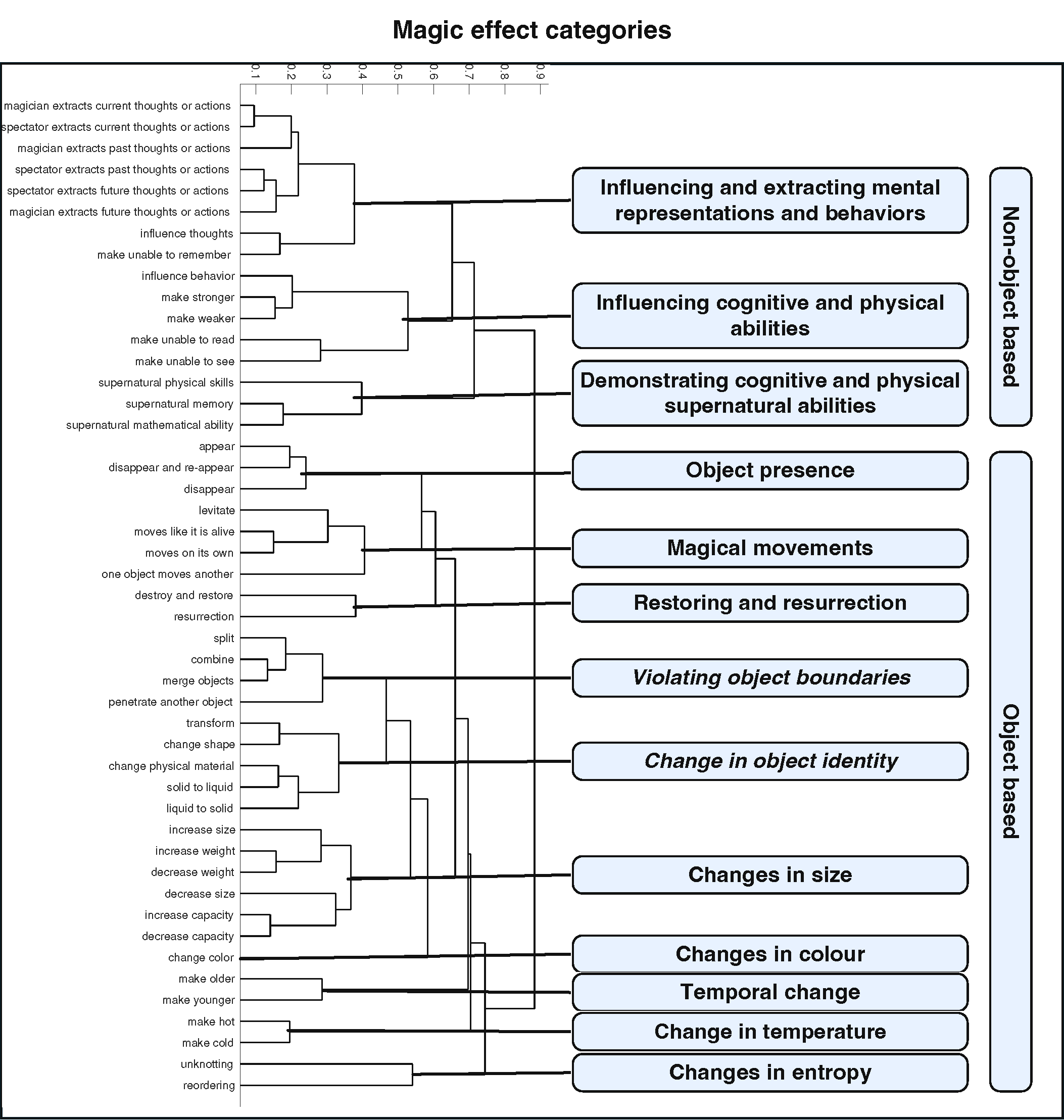
This map can also help with routine construction. If you want variety, select effects from different regions rather than performing several tricks that feel psychologically similar. A production, a transformation, and a prediction may create more variety than three effects that use different props but produce essentially the same experience.
The science of magic is not about reducing performance to numbers. It is about seeing familiar problems from a different angle. By combining the practical knowledge of magicians with evidence about how audiences actually think and feel, we can better understand what makes magic powerful.
So, the next time someone asks what kind of magic you perform, consider going beyond cards, coins, or mentalism. Ask yourself two deeper questions: What does my audience experience, and what do I want them to believe caused it?
Additional resources
The original research paper “A folk taxonomy of magic”: https://www.sciencedirect.com/science/article/pii/S0010027726001770
Link to the MAGIC Lab: https://www.magicresearchlab.com
Link to the Science of Magic Association: https://scienceofmagicassoc.org
Link to The Psychology of Magic: From Lab to Stage: https://www.vanishingincmagic.co.uk/ebooks/psychology-of-magic-from-lab-to-stage/
About the Author: Gustav Kuhn
 Gustav Kuhn, born in Switzerland, discovered his love for magic at the age of 13, dedicating much of his teenage years to mastering the art of illusion and deception. At 19, he moved to London to pursue his dream of becoming a professional magician. However, his path took an unexpected turn when he discovered a deep interest in psychology. This fascination led him to study psychology at Sussex University, and by the end of his PhD, he realised a powerful connection between magic and the mind.
With a unique background that merges science and magic, Gustav began to bridge these two worlds, establishing a new field: the Science of Magic. His work was recognised with a prestigious Wolfson Research Fellowship at the University of Durham, where he developed this emerging field. Throughout his career, he held academic positions at Brunel University, Goldsmiths, University of London, and Harvard Medical School, further cementing his expertise.
Now a Professor in Psychology and the Science of Magic at the University of Plymouth and the Director of the MAGIC Lab, Gustav is a leading figure in the Science of Magic. He is also the founding member and president of the Science of Magic Association. With two acclaimed books on the psychology of magic under his belt, Gustav Kuhn continues to be a sought-after speaker, delivering keynote addresses that explore the fascinating interplay between magic and the mind.