News
Nero discovered the magic square many years ago. For him it was a revelation: mathematics that could become magic. At first glance, it looks like one of those things for professors with chalk in their hand and a tight tie around their neck.
A grid of numbers, four rows, four columns, and off you go: you add this way, you add that way, you add diagonally, you add the corners, you add the little square in the middle, and the result is always the same. Always. You can turn it, turn it back, approach it from the side, try to cheat it: it comes back there, unchanged. In mathematics, the magic square is a serious matter: every row, every column and the two diagonals must give the same sum, the so-called magic constant. The simplest one, with the numbers from 1 to 9, always gives 15. Clean, orderly stuff. Almost innocent.
The Conjurer’s Grid
 But in the hands of a conjurer, that grid immediately stops being innocent. Nero had seen it performed dozens of times. A spectator named a number. Seventy-five, for example. The magician took a marker, drew four rows and four columns, filled the boxes in a few seconds, with the air of someone jotting down a shopping list, and then began the check. First row: 75. Second: 75. Third: 75. Fourth: 75. Columns: 75. Diagonals: 75. Corners: 75. Centre: 75.
At that point, the audience no longer knew whether to applaud or call an accountant. Because that was precisely the beauty of it. The magic square did not look like a trick. It looked like proof of lightning-fast intelligence, superhuman memory, impossible calculation. Or, in the best cases, numerical destiny. The chosen number could become a date of birth, an age, an anniversary, a prediction, a kind of personal frequency. And then the game was no longer just a little game. It became a story.
The risk, of course, was always just around the corner. If you presented it badly, the magic square became as cold as a bowl of soup left on the windowsill. An after-dinner puzzle. Something from a puzzle magazine. But if someone good got their hands on it, everything changed. Nero still remembered Juan Tamariz’s version. Not a demonstration: a celebration. Controlled delirium. A wild parade of numbers, laughter, feigned confusion, revelations, wide-open eyes. Tamariz did not perform the magic square: he danced inside it. And the audience, poor souls, followed him happily, like their own Pied Piper.
Then there was Durer. There too, Nero always paused for a moment. Albrecht Durer, in his engraving Melencolia I, in 1514, had inserted a 4×4 magic square with a constant of 34. And in the bottom row there were precisely the numbers 15 and 14: the year of the work. A hidden signature, a wink, a small door left ajar inside a masterpiece. Because magic squares are like that: they seem closed, but instead they open.
The Square Without Numbers
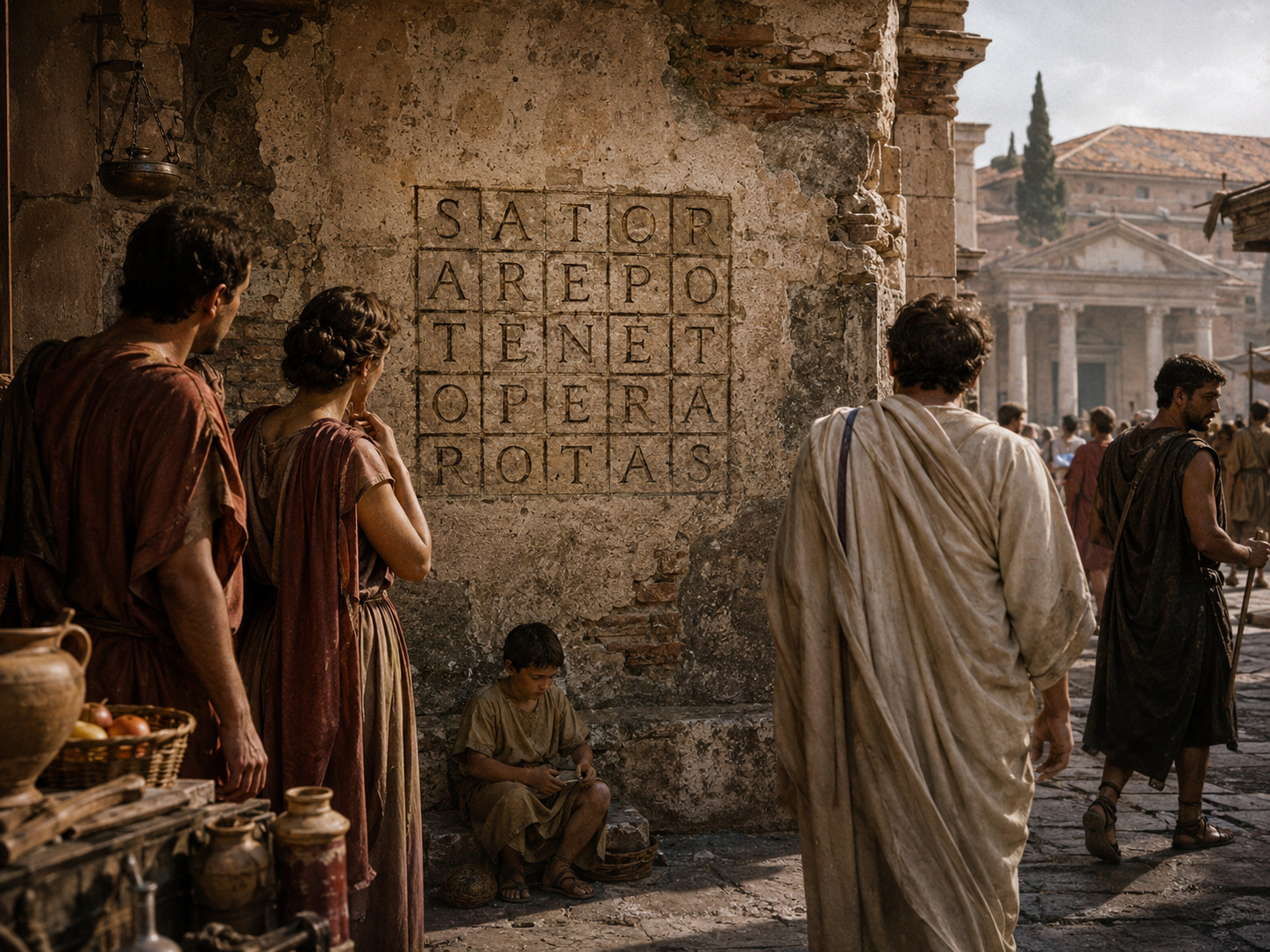
And then there was the other square. The one without numbers. The one that is not added up, but read. Or perhaps it is not even read: it is contemplated. The SATOR. Five words. Twenty-five letters.
SATOR — AREPO — TENET — OPERA — ROTAS
Nero had come across it in books, in photographs, on ancient walls, in churches, on stones. But every time it had the same effect on him: it seemed like little, and yet it was too much. Too orderly to be a simple scribble. Too obscure to be only a game. In Pompeii they had carved it before Vesuvius did its terrible work, wiping out an entire city and leaving posterity pots, beds, bodies, writings, curses, loves and mysteries. Then the SATOR reappeared elsewhere, across half of Europe, as if someone had sown that Latin square along the roads of history. And indeed that word, Sator, meant precisely “sower.” Yes. But sower of what?
If you looked at it calmly, the square was a perfect little mechanism. It could be read from left to right, from right to left, from top to bottom and from bottom to top. At the centre, TENET formed a cross. A precise, stubborn cross, almost too beautiful to be accidental. In front of those five words, Nero always felt the same little tingle. The one he felt when a story did not want to be caught straight away. When it seemed to say: come on, step forward, but watch where you put your feet.
The most cautious translation was also the strangest: “The sower Arepo carefully holds the wheels.” Exactly. Arepo. That was where the donkey stumbled. Because Arepo, in classical Latin, cannot be found. It may be a proper name, a foreign word, an invention needed to make the mechanism work. An elegant wedge. A bolt slipped in where the right piece was missing. And so that square became even more fascinating: a perfect machine with a key no one has anymore.
Mystery, History, and Legend
Those who love the arcane, naturally, did not stop there. They took the letters, rearranged them, and found the word Paternoster twice, set out as a cross. Two A’s and two O’s remain: Alpha and Omega, beginning and end. And there comes the Christian hypothesis: the SATOR as a secret symbol of the first believers, a hidden sign by which to recognize one another when the new religion could not yet walk openly in the sunlight.
A beautiful hypothesis. Perhaps too beautiful. Because history, which is a severe and rather unpleasant lady, urges caution. The oldest examples are Pompeian, and Pompeii does not give us solid evidence of an organized Christian community. Moreover, the earliest versions seem to begin with ROTAS, not SATOR. It may be that Christians, later on, adopted that square, attracted by the hidden cross and by that play of Alpha and Omega. But saying they invented it is quite another matter.
In the Middle Ages, however, the SATOR changed profession. It stopped being an enigma and became an amulet. They wrote it against fires. Against diseases. Against the evil eye. To protect difficult childbirths, houses, animals, fields. Five words that perhaps no one truly understood anymore, and which for that very reason seemed powerful. Because when man does not understand, he often kneels. Or becomes afraid. Or builds a legend upon it.
The supporters of the mystery say: too many coincidences. Too much symmetry. Too many recurring symbols. The sceptics reply: steady on. From twenty-five letters you can draw out quite a lot, especially if you start with the idea of finding what you already want to find. Nero listened to both sides. Not because he liked sitting in the middle for convenience. No. The middle, at times, is the most uncomfortable place of all. But certain stories must be looked at that way: with one eye lit up and the other suspicious.
On one side, the numerical square of the conjurers: the one that adds, fits together, astonishes, and if you present it well can bring the theatre down. On the other, the verbal square of the SATOR: the one that does not give a total, but opens a question. It does not say “seventy-five.” It says: try to understand me, if you can.
And perhaps that was exactly the difference. The magic square of numbers is a lock the magician already knows how to open. The SATOR, instead, is an ancient door that has remained closed. Maybe there is nothing behind it. Maybe it is only a Roman game, a wall pastime, a kind of crossword before crosswords. Maybe a boy from Pompeii, seeing us argue over it for two thousand years, would laugh like mad and say: “Why are you so obsessed with it? It was obvious.” Obvious to him. Not to us.
And so the square remains there. Silent, stubborn, perfect. With its five words lined up like little soldiers and its mystery in the middle, fixed inside that cross of letters. Nero looked at it once more. And he thought that, in the end, magic squares are all the same: the ones with numbers and the ones with words. They promise you order. And then, if you are lucky, they hand you the enigma.
About the Author: Luciano Donzella
 Luciano Donzella is a professional journalist, author, and magic historian. Former staff writer at Il Tirreno(1984–2016), he has published three books and authored the official book of the FISM World Championships of Magic 2025 in Turin. President of the magic club Corte dei Miracoli since 1993, founder of the House of Magic, and organiser of the Italian Congress on the History of Magic, he performs under the stage name “Nero” and has taught magical arts for over twenty years.