News
Portland, Maine, February 1937. That was where Nero would have liked to be, on one of those cold American evenings, sitting in the darkness of a Keith’s circuit theater, still wearing his coat, with the audience’s breath mingling with the smell of wood, velvet, and fear. The poster read: Mysteries.
The man on stage was called Rajah Raboid. A name fit for a fakir, for some Eastern prince bought wholesale at the marketplace of illusions, with just enough exotic flavor to make the spectators prick up their ears. In reality, his name was Maurice Kitchen. But the audience did not know that. And, above all, they would not have cared. The Rajah moved across the stage with a solemn step, like those men who know more than everyone else and are in no hurry to reveal it. At a certain point, he called up several spectators. He hypnotized them, or so it seemed. He sent some of them back to their seats. He kept two.
The Rajah and the Trick Box
Then, with the voice of a man about to do something extraordinary, he said more or less this: “You have all seen the famous illusion of the woman sawed in half. But magicians use assistants. I do not. I shall do it with one of you.” Now, at that point, Nero would already have settled comfortably in his seat. Because when a magician says “one of you” in a theater, he is often not really talking about “one of you.” He is talking about someone who looks enough like you to make you doubt. And doubt, in magic, is already half a miracle.
One of the two spectators was made to sit to one side. The other was laid down on a table. A box was brought in. The spectator was placed inside it. The Rajah picked up a woodman’s saw and began to saw. At that point the second spectator, the one left watching, shouted: “It’s a trick box!” Beautiful. Faced with a device like that, Nero would have smiled under his mustache. Because the false solution is one of the most refined things there is. You give the audience a culprit, and they sink their teeth into him. You let them believe they have understood, and just as they are congratulating themselves on their intelligence, you pull the floor out from under their feet.
The Rajah, in fact, did not take offense. On the contrary. He dismantled the box. Piece by piece. Off came the lid, off came the walls, off came everything. In the end, there remained on stage only that man lying on a thin table, almost nothing at all, more like a tavern plank than a platform for a miracle. No boxes. No curtains. No covers. No dancers passing in front, no smoke, no darkness. Only the man, the table, the Rajah, and the saw. And then he sawed him. Just like that, in front of everyone.
Give Me Back My Legs
Now, a normal audience, faced with something like that, prepares itself for the restoration. Because magic, deep down, is also an education in hope: they show you disaster, but you know that somehow everything will be put right again. Except here, nothing was put right at all. The moment the cut was made, the unbelievable happened, even for someone in the trade: the man’s legs rose up and began running around the stage by themselves. By themselves. The legs.
Nero could imagine it, that first second of silence. That second in which no one yet has the courage to scream because the brain, poor thing, is still trying to decide which drawer to put what it has just seen into. Then the torso jumped down from the table and, walking on its hands, launched itself after the legs. “Give me back my legs! Give me back my legs!”
And the theater became a thunderstorm sealed inside a box. Women screamed, men sprang to their feet, someone fled toward the aisle, someone fainted. It is said that over two years of performances they counted several serious cases of illness. Perhaps the number grew in the telling, as always happens when a story is too good to remain its proper size. But the panic, no, that must have been real. Sometimes the legs even ran down into the auditorium. The torso chased them among the spectators, only a few steps from the front rows, with that desperate voice: “Give me back my legs!” Do you understand? It was not a flash. Not a three-second effect. It lasted. The thing breathed. It moved. It came toward you.
At the end, the stagehands grabbed the legs. Then the torso. They put them back together on the table. The Rajah made a gesture, as if smoothing out a crease in the tablecloth. “What are you screaming about? Everything is all right.” The man looked at himself. Touched himself. Incredulous. Then, changing tone, he said: “Give me back… my jacket.” And he returned to his seat in the audience. People could look at him, touch him, ask him questions. He was whole. Alive. Normal. The end.
The Real Illusionist
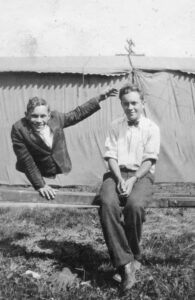 Now, told like this, one thinks: all right, great trick, great mechanics, great secret. And indeed there was a secret. More than one, in fact. But the point, as always with truly great things, was not only there. The spectator was a stooge. Actually, there were two: two brothers, Robert and Johnny Eckhardt, born in Baltimore in 1910. Robert was a man like any other. Johnny was not. Johnny had been born without the lower part of his body. From the navel down, quite simply, there was nothing.
Johnny Eck was anything but a “half-man”; if anything, he was a double man. He had extraordinary strength, grace, and stage presence. He walked on his hands as others walk on sidewalks, and it seems he was capable of balancing on one arm alone with an almost insolent naturalness. For the illusion, a third accomplice was also needed: a dwarf hidden inside an enormous pair of trousers, with a wooden disk on his head, so as to simulate the lower part of a man, the legs. And then switches, timing, entrances, exits, acting, psychological cover more than physical cover. Real theater stuff. The work of people who do not merely build a machine, but build a perception.
But the beautiful part, the truly beautiful part, came later. Because Rajah Raboid, the great magician whom the audience applauded and feared, was not a magician. He was an actor. The real illusionist, the man who had conceived the act, the soul and the brain behind that impossible illusion, was Johnny Eck himself.
The Art of Disappearing
Whenever Nero reached this point in the story, he always paused for a moment. Because there lay a lesson worth more than a thousand lectures on magic, on theater, and on that little beast every artist carries in his pocket and calls “I.”
Johnny Eck had devised the most shocking effect of his time. He had the right body, the right mind, the right courage. But he had understood one terrible, crystal-clear thing: if he had presented himself as the magician, the audience would have looked at Johnny before the miracle. They would have seen his condition, guessed the path, perhaps felt pity. And pity, in theater, is an ugly beast. It walks onto the stage with muddy shoes and ruins everything.
So Johnny did something enormous. He stepped back. He put someone else at the center of the stage. He, the true creator, became “the spectator.” The fake volunteer. The cut body. The victim. The miracle. And he let an actor, Maurice Kitchen, take the cloak, the exotic name, and the magician’s applause. One has to take one’s hat off to that.
Because ego, in certain professions, is like a dog pulling on the leash. It convinces you that you must always be in front, always lit up, always named. Johnny Eck, instead, understood that in order for the act to live, he had to disappear inside the act. He had to become theatrical matter. He had to give up the place of honor in order to obtain something greater than the place of honor: the absolute effect.
And then there was that line. “Give me back my legs.” Nero could not consider it mere acting. Of course, it was theater. Of course, it was a script. Of course, it was part of the trick. But inside it, beneath it, there was something that could not be manufactured with plywood and hinges.
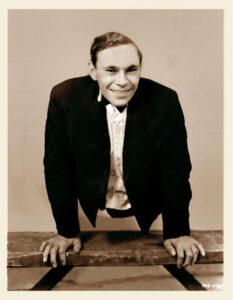 Johnny Eck, a cheerful man, an intelligent man, an exquisite artist, was in that moment shouting a truth no magician could have invented. He was shouting it to the audience, but perhaps also to God, or to fate, or to that distracted midwife who had delivered him into the world without half a body.
“Give me back my legs.” And the audience felt it. Perhaps they did not understand it. But they felt it. That was why the effect was frightening. Not because the trick could not be seen. But because something far too true could be seen.
Theater works like that, Nero thought. On one side are those sitting in the dark, with fears, desires, wounds, and shames that in everyday life they keep buttoned tightly upon themselves. On the other side are those on stage, who by profession, necessity, or recklessness undress in front of others.
And when someone on stage truly tells the truth, even disguised as a trick, a farce, a monstrosity, a sideshow act, the audience recognizes it. They may not know how to name it, but they recognize it. Like a dog sensing an earthquake before a man does. Johnny Eck knew this.
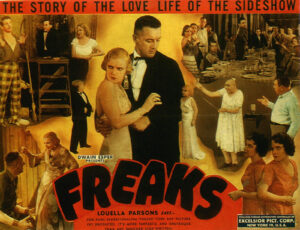 He was not merely the protagonist of a physical anomaly. He was an artist. He had worked in cinema; he had appeared in 1932 in Tod Browning’s Freaks, that cursed and magnificent film which, even today, looks at you more than you look at it. He was a musician, a draftsman, an actor, a fantasist. He was also a fine manipulator: balls, thimbles, sleight-of-hand effects. Not one of those performers who say, “Look how good I am,” but one of those who make you want to come closer to understand where technique ends and poetry begins.
Except that his masterpiece could not be performed by him as a magician. He performed it by disappearing. And that, it must be said, is genius. The show continued until the end of 1939. Then the world changed, theaters changed, cinema swallowed up part of that audience, and a production involving thirty people became too heavy a ship to keep afloat. The equipment passed into other hands, then partly vanished, as often happens with objects of magic: they are born to guard secrets and end up becoming secrets themselves.
Johnny Eck continued his life as an artist. He died in 1991 in Baltimore, the city where he had been born, and is buried at Green Mount Cemetery together with his brother Robert.
And whenever Nero thought back on that story, one simple thing came to mind. One of the greatest illusions of the twentieth century was not merely a man sawed in half who ran after his own legs. It was an artist who knew how to disappear in order to make his own miracle immortal. And that, when you think about it, is a trick almost no one knows how to do.
I thank P. G. Varola, a great expert in the history of magical art, for sharing this story with me many years ago, and for inspiring me to grasp its true magical essence.
About the Author: Luciano Donzella (Nero)
 Luciano Donzella is a professional journalist, author, and magic historian. Former staff writer at Il Tirreno (1984 to 2016), he has published three books and authored the official book of the FISM World Championships of Magic 2025 in Turin. President of the magic club Corte dei Miracoli since 1993, founder of the House of Magic, and organiser of the Italian Congress on the History of Magic, he performs under the stage name “Nero” and has taught magical arts for over twenty years.